
JOHN C. WEIBULL - ART: MY FIRST LANGUAGE
Beyond the World Record:
A Conversation with Rubia Caldeira on Art, Childhood and the Freedom to Create
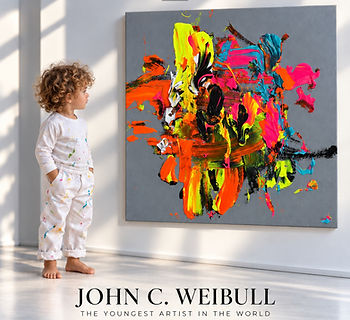
At an age when most children are only beginning to discover the world around them, John Christian Caldeira Weibull was already making his mark on canvas.
Recognized by Guinness World Records as the youngest male artist at just 10 months and 7 days old, the Swedish-Brazilian child artist has attracted international attention for his abstract paintings. Yet behind the remarkable record lies a more personal story — one that began not with an ambition to enter the art world, but in his mother's studio, surrounded by brushes, canvases and colour.

John's mother, Rubia Caldeira, is herself an artist whose practice is rooted in figurative painting and hyperrealism. Accustomed to precision and carefully considered detail, she found herself observing an entirely different approach to creativity through her son: spontaneous, instinctive and unconcerned with perfection. What began as an everyday part of their lives has since become an artistic journey that has influenced not only John's development, but also Rubia's own understanding of art.
Now, as John prepares for his solo exhibition, ART: MY FIRST LANGUAGE, at MIVA Fine Art Gallery in Malmö, Sweden, from November 20–22, 2026, his story raises questions that extend far beyond the extraordinary circumstances of his age.
What does artistic expression look like before a child can fully explain his intentions? How do adults interpret creativity that exists outside conventional artistic training? And how can a family preserve the freedom of childhood when that creativity begins attracting international recognition?
For HOLLYWAY Magazine, Rubia Caldeira reflects on John's earliest encounters with painting, the unexpected ways his creative process has evolved, and the delicate balance between celebrating a child's achievements and allowing him simply to be a child.

EXCLUSIVE INTERVIEW
A Conversation with Rubia Caldeira
THE EVOLUTION OF JOHN'S ART
HOLLYWAY: John's artistic journey began before he could speak. Looking back at his earliest paintings and comparing them with his most recent works, what changes have surprised you the most? Are there particular gestures, colour combinations, or creative habits that have become distinctly his own?
RUBIA CALDEIRA:
John's relationship with painting began very naturally. When he was born, I was working on commissioned paintings with deadlines to meet. I was breastfeeding at the time and had the help of a nanny, who would bring him to my studio whenever he woke up. I would often breastfeed him while I worked. From his very first days, he was surrounded by canvases, brushes and colours. In a way, he practically grew up inside an art studio.
What amazes me now is how that early exploration has evolved into increasingly independent choices. At first, he was discovering movements, materials and colour. Today he tells me when he wants to paint, chooses his colours and even mixes shades to get exactly what he has in mind. Sometimes the blue in front of him isn't quite the blue he wants. He'll combine blue, grey and white, experimenting until he finds a different tone.
Another remarkable change has come with his physical development. When John first started painting, he could not even walk. Today, he can walk while painting, hold a canvas himself and turn it around when he is not satisfied with what he sees. As his body has developed, so have the possibilities of how he interacts with his paintings. Movements that were once physically impossible have gradually become part of his creative process.
As both his mother and an artist, I find it fascinating to see his own preferences emerge. I cannot know precisely how much that early environment influenced his interest, but painting has been part of his everyday world from the beginning.
PAINTING AND PLAY
HOLLYWAY: At John's age, painting can be both an artistic activity and a form of play. Have you noticed moments when he seems to approach the canvas differently from other playful activities, perhaps showing unusual concentration, intention, or a desire to return to a particular idea?
RUBIA CALDEIRA:
One of the most fascinating things I've discovered while observing John is that, for him, painting and playing seem to belong to the same world.
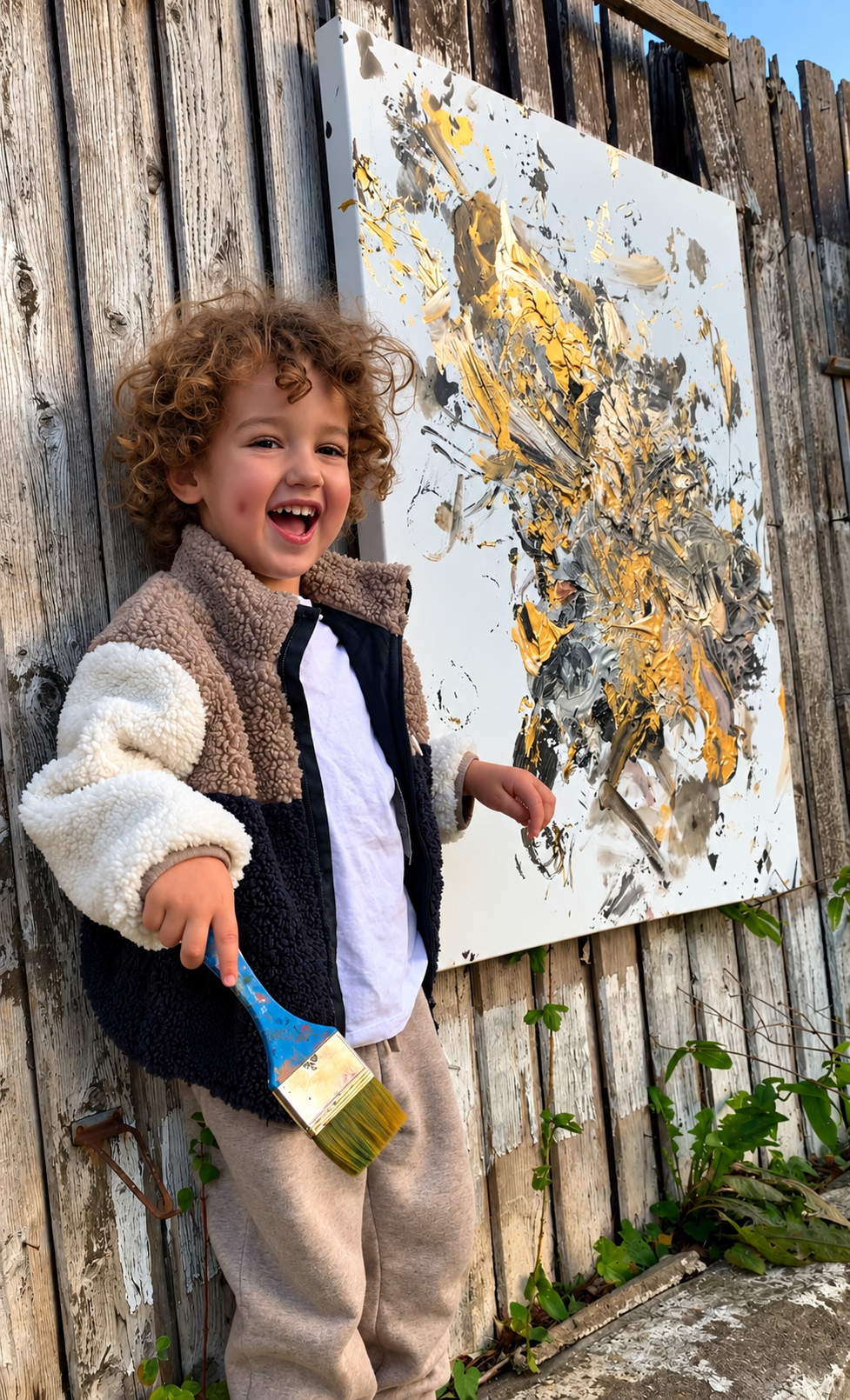
When he was a baby, he had a toy with a little ladybird that moved up and down a tree. He was completely fascinated by that movement and watched it over and over again. Some time later, I noticed something remarkably similar when he painted: he would deliberately place a paint-covered brush against the canvas and let it slide, watching the trail of colour it left behind.
Sometimes he waited for the brush to fall, picked it up and began again. Other times, he caught it mid-movement and tried a different direction. What fascinated me most was seeing his little body lean forward and back as he followed the brush, completely absorbed in what was happening.
As both his mother and an artist, I was so intrigued by that resemblance that I gathered clips from different moments into a short film called 'Slide on Canvas'. I still recognise that gesture in some of his paintings today.
I can't say that the ladybird inspired it; perhaps it was coincidence. But it showed me how something so simple in childhood might reappear in another form on a canvas. Sometimes a child's art begins exactly where we adults see nothing more than play.

DIFFERENT EYES, DIFFERENT STORIES
HOLLYWAY: Adults often search for meaning in abstract art, even when the artist has no intention of explaining it. Have you ever watched someone interpret one of John's paintings in a way that surprised you, especially when you knew the circumstances in which he created it?
RUBIA CALDEIRA:
People constantly surprise me with their interpretations of John's paintings, particularly through the messages we receive on social media. Someone sees a little bird; someone else sees a man drinking coffee. Completely different stories can emerge from the same painting.
I often read those messages to John, and sometimes we sit together and talk about what people have noticed. He finds his own images and forms, too.
As a figurative artist, I am used to working with recognisable subjects, so I find these unexpected readings particularly interesting. I don't feel the need to explain what every painting means. One of the beautiful things about art is the space it leaves for someone else to discover something personal.
Imagination has no borders.
RECOGNITION AND CHILDHOOD
HOLLYWAY: John's work entered the professional art world at an extraordinarily young age. How do you protect the spontaneity of his creative process while navigating exhibitions, collectors, media attention, and the expectations that naturally come with international recognition?
RUBIA CALDEIRA:
At home, John's life hasn't changed because of the recognition. Of course I'm happy and grateful for it, but he doesn't yet understand what a Guinness World Record means. He goes to preschool, plays with friends and discovers the world like any other child.
Just yesterday, as we often do, we went to the playground. We were making little figures out of sand, using small stones for eyes and autumn leaves for hair. John noticed that the leaves were almost the same colour as his own hair. Those simple moments are the childhood I want to protect.
I encourage his interest in painting, but I don't want exhibitions, collectors or titles to turn into expectations he must fulfil. I hope his story can encourage other parents to notice what excites their own children—not so they can chase records, but so they have room to explore and discover what they love.
A painting can last for generations. Childhood cannot. For me, his childhood comes first.

A CHOICE OF HIS OWN
HOLLYWAY: Has John ever surprised you by rejecting a colour, changing the direction of a painting, or expressing a clear preference that challenged what you expected him to do? We'd love to hear about a specific moment when his artistic independence became particularly visible.
RUBIA CALDEIRA:
John has a determined personality. These days he often comes to me and says, 'Mum, let's paint!' He chooses his colours and mixes them himself. I help with what he is still too young to manage, like setting up the canvas, but I try to leave the creative decisions to him.
There is one evening in Spain I will never forget. John was around nine or ten months old. It was already about eight or nine at night, and we were getting ready for bed. As we passed his studio, he began crying and pointing insistently towards the door.
At first, I couldn't understand what he wanted. He kept pointing and trying to reach the door, so I opened it. He went inside and almost immediately calmed down. I wondered whether he wanted to paint, so I prepared a canvas and offered him some paint. He began painting happily.
I was so surprised that I filmed the whole moment and later showed it to his father. I hadn't planned any painting session that night. What stayed with me wasn't just the painting; it was his insistence on going into that room.
It reminded me to observe more carefully what a child is trying to communicate, even before words are available. We can't decide our children's interests in advance, but we can pay attention and give them opportunities to explore.
WHAT JOHN HAS TAUGHT ME
HOLLYWAY: Many artists spend years trying to rediscover the freedom and fearlessness they experienced as children. Watching John create without the conventions or expectations of formal artistic training, has his approach changed the way you personally understand art?
RUBIA CALDEIRA:
Absolutely. I am a figurative artist and work in hyperrealism. I am very detail-oriented, both in my paintings and in my personality. I can spend hours refining a tiny detail, searching for precision.
For a long time, abstract art didn't particularly attract me. Then I began watching John. He chooses a colour, makes a movement, looks at what happens and seems genuinely happy with it. While I might spend hours perfecting one small area, he finds delight in a simple gesture.
Naturally, we have very different artistic practices and experiences; one is not better than the other. But his spontaneity has made me think about how much pressure we adults sometimes put on ourselves. We can become so focused on the result that we forget the joy of discovery.
John has helped me see beauty in imperfection and remember that freedom, too, has a place in the creative process. I am the mother supporting him, but also an artist learning from watching my son.
Watching John has also influenced the direction of my own work. I have always painted figurative subjects, especially female figures, but recently I began developing a new collection called Emotional Anatomy. I remain a figurative artist, yet I am exploring how to bring a deeper emotional dimension into my paintings.
John's way of creating helped me discover another artistic language, not by changing who I am as an artist, but by expanding the way I express what I feel.

ART: MY FIRST LANGUAGE
HOLLYWAY: The title of John's upcoming exhibition, ART: MY FIRST LANGUAGE, suggests that creativity can communicate something before words become available. What inspired this title, and what do you hope visitors will understand about John's work beyond the remarkable circumstances of his age?
RUBIA CALDEIRA:
For me, ART: MY FIRST LANGUAGE reflects something very personal in John's story. The title was inspired by watching him explore painting as a form of expression long before he had the words to describe his experiences.
From the beginning, colours, movements and materials were part of the way he discovered and interacted with the world. I don't believe every brushstroke needs to carry a message that we can translate into words. Sometimes, expression exists simply through the act of creating.
From a curatorial perspective, I hope the exhibition invites visitors to look beyond the remarkable circumstances of John's age and engage with the paintings themselves. Each work holds its own visual language through colour, movement, texture and composition. Together, the paintings also reveal an evolving relationship with the canvas.
I find that dual perspective particularly interesting: each painting can stand on its own while also belonging to a larger story of discovery. Ultimately, I hope visitors and collectors feel free to establish their own connections with the artworks, without being told what they should see or feel.
For me, the beauty of this exhibition lies precisely in that freedom. It is an invitation to experience the paintings not only through the story of the child who created them, but through the emotions, questions and interpretations they may awaken in each person.
CHOOSING THE WORK
HOLLYWAY: When preparing an exhibition for an artist who is still discovering the world, how do you decide which paintings should be presented? Is the selection guided by visual composition, the story behind each work, or the changes you have witnessed in his creative development?
RUBIA CALDEIRA:
When I look at John's paintings, what strikes me most is the rawness of his expression. There is something pure and unfiltered about the way he creates.
The selection of works for this exhibition happened very naturally. As John continued painting, we gradually brought the works together. We were not looking for the most beautiful painting or trying to construct a particular aesthetic. We were allowing his creative journey to unfold.
John's paintings are not created to meet expectations or follow a predetermined artistic direction. They are the result of his own exploration of colour, movement and materials. As an artist, I understand the temptation to refine, adjust or perfect something. But with John's work, I believe the opposite is essential. There is no need to polish what was never intended to be polished.
Each painting exists as an honest expression of a particular moment. Together, the works reveal the natural evolution of a child discovering his own relationship with art.
For me, this exhibition is about art without filters: art in its rawest, most instinctive and unfiltered form. There are no preconceived ideas of what is right or wrong, no expectations of what a painting should look like, and no attempt to refine or correct what John creates. What we see on the canvas is simply his expression, exactly as it emerged.
As an artist, I find something deeply fascinating in that freedom. We spend years learning techniques, developing artistic languages and sometimes trying to free ourselves from the very rules we have learned. John is simply creating, without those expectations. And perhaps that is what makes this exhibition so meaningful to me: it allows us to encounter art before the filters.
BEYOND HIS AGE
HOLLYWAY: John's paintings are already being viewed, exhibited, and collected as works of art. Do you think there is something fundamentally different about experiencing a painting when you know it was created by a very young child? And would you want viewers to respond to his work differently if they didn't know his age?
RUBIA CALDEIRA:
Knowing John's age naturally creates surprise, and I understand that. But I often wonder how someone would respond if they encountered the same painting without knowing who had made it. Would they notice the colours and forms in the same way? Would they find their own images and stories?
I find different interpretations fascinating. They do not cancel out what I saw while John was painting; they add new layers. As a figurative artist, I am used to working with recognisable forms, but his paintings have made me appreciate the openness of abstract art in a different way.
Sometimes I share people's interpretations with him, and we talk about what they saw. Art naturally invites different interpretations, emotions and opinions, including criticism. Not everyone has to see or feel the same thing, and that is perfectly fine.
I don't expect everyone to admire his work because of his age or a world record. I would love them to encounter the painting first, make up their own minds, and then, if they wish, discover the story of the child who made it.
IF HE CHOOSES ANOTHER PATH
HOLLYWAY: Childhood is constantly changing, and interests can evolve in unexpected directions. If John eventually discovers another passion or decides that painting is no longer something he enjoys, how would you approach that change?
RUBIA CALDEIRA:
I would support him completely. John is still discovering the world. Today he enjoys painting; tomorrow he may discover an entirely different passion. I want him to have that freedom.
I hope he grows up knowing that his curiosity is welcomed and that mistakes and experimentation are nothing to be ashamed of. There is a difference between encouraging a child's interests and turning them into obligations. My role is to offer opportunities, pay attention and help him discover what he enjoys, not to decide his future for him.
Whether he continues painting or chooses something completely different, I hope he knows that his value does not depend on records, titles or achievements. Our love and support are not connected to what he produces, but to who he is.

LOOKING BACK
HOLLYWAY: Years from now, when John is old enough to look back at his earliest paintings and the extraordinary attention surrounding them, what do you hope he will discover about himself through this collection of memories and artworks?
RUBIA CALDEIRA:
Years from now, I hope John will look at these paintings and discover more than the story of a young artist. I hope he will recognise something of the child he once was: how he explored the world, how his movements evolved, how his curiosity developed and how, little by little, he began discovering his own individuality.
Childhood is a remarkable period of human development, and creative expression can offer a glimpse into that journey. These paintings, together with the photographs and videos documenting their creation, preserve moments of his growth that words alone could never fully capture. Perhaps one day, John will see in them a visual history of his own becoming.
Above all, I hope that when John looks back, he sees a childhood filled with curiosity, joy and freedom. I hope these paintings remind him not only of what he created, but of everything he was discovering along the way.
When John first started painting, I had no idea where it would lead. I wasn't thinking about world records or exhibitions; I was watching my son discover something he enjoyed. Along the way, I discovered something myself. As an artist, he reminded me that creativity doesn't always need rules or explanations. As a mother, he reminded me that children have their own ways of exploring the world, sometimes before they can tell us what they feel or want.
And perhaps, as he grows older, John will discover that his story has inspired other children to explore their own creativity. Not necessarily to become artists, but to believe in their own curiosity, embrace their individuality and discover what brings them joy. If his journey can encourage a new generation to express themselves freely, that would be something truly meaningful.
I am still learning every day as a mother, and I certainly don't have all the answers. But I hope we continue to give children our time, attention and space to explore their interests. Sometimes, the most extraordinary thing we can do for a child is simply give them the freedom to be a child.
Beyond the Canvas
For John C. Weibull, painting began long before the world knew his name. What has since become an internationally recognized artistic journey remains, in his everyday life, something far simpler: an opportunity to explore colours, movement and the pleasure of creating.
His story also reveals an unexpected exchange between two generations of artists. While Rubia Caldeira introduced her son to a world filled with canvases and brushes, John's instinctive approach to painting has, in turn, challenged her own understanding of artistic expression. Where her practice has traditionally pursued precision, his invites spontaneity. Where she once searched for perfection in detail, she has begun to discover new possibilities in imperfection.
Their experiences offer two different perspectives on creativity, connected not by technique or artistic discipline, but by curiosity.
As ART: MY FIRST LANGUAGE approaches, the exhibition presents an opportunity to encounter John's paintings both as individual works and as a visual record of his earliest years. Visitors may discover unexpected forms, personal associations or entirely different interpretations within the same compositions. The meaning of those works need not be fixed by the artist's age, his record or the circumstances of their creation.
Perhaps the most compelling aspect of John's journey is not what he has already achieved, but how much remains unknown. Whether painting becomes a lifelong pursuit or simply one chapter of his childhood is a question that only time can answer.
For now, the canvases preserve something that cannot be recreated: the gestures, discoveries and fleeting moments of a child learning to express himself.
And beyond the exhibitions, recognition and extraordinary headlines, one principle remains central to his mother's perspective: the freedom to grow, to change and to discover a path of his own.

EXHIBITION INFORMATION
ART: MY FIRST LANGUAGE
John C. Weibull — Solo Exhibition
MIVA Fine Art Gallery
Malmö, Sweden
November 20, 2026 — VIP Preview (Invitation Only)
November 21–22, 2026 — Public Exhibition
Artist: John C. Weibull
Interviewee: Rubia Caldeira
Interview: HOLLYWAY Magazine
Instagram: @johncweibull
Exclusive interview for HOLLYWAY Magazine.


